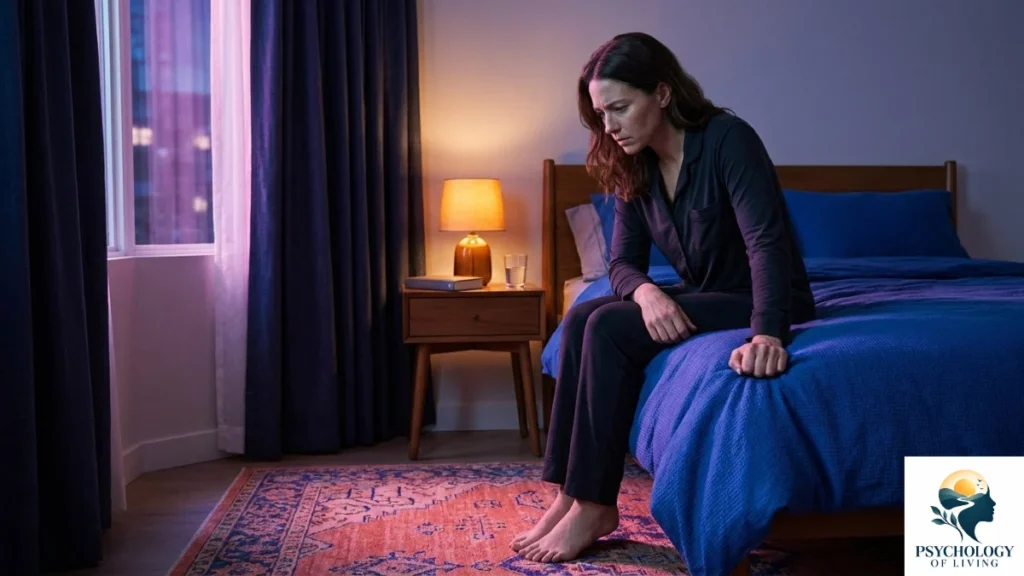
Short answer: it isn’t your imagination, and it isn’t one thing. At night, three things tend to stack up. The distractions that kept your worries at bay all day switch off. A tired brain has a weaker grip on its own alarm system. And lying awake worrying about sleep adds a fresh layer of worry on top.
Understanding the mechanics won’t make a 2 a.m. spiral pleasant, but it changes how you read it. The thoughts that feel like urgent truths at that hour are, in large part, products of the hour. This piece follows the night in order, from the evening wind-down to the small hours, then covers what actually helps and when it’s worth getting more support.
Evening: the distractions leave
All day, something else is asking for your attention: messages, meetings, noise, other people. Your worries exist then too, but they have to compete for airtime. In a dark, quiet bedroom, they don’t.
That’s the starting point for a Baylor University sleep study I’ll return to below. Its lead researcher, Michael Scullin, began from the observation that many people climb into bed and keep cycling through unfinished tasks in their heads. Add anxiety and those tasks turn into “what if” questions.
I’ll be upfront that this part is more intuition than experiment. The next two sections rest on firmer evidence.
Lights out: a tired brain has a weaker brake
The emotional alarm in your brain is the amygdala. Its brake is the prefrontal cortex, which helps put threats in context. Sleep loss seems to weaken the brake.
In a UC Berkeley and Harvard study, 26 healthy adults who stayed awake for about 35 hours were shown increasingly upsetting images. Compared with rested volunteers, their amygdalae were more than 60 percent more reactive, and the connection to the prefrontal cortex looked weaker. Lead researcher Matthew Walker described the result as the emotional centers running amok.
A later paper, “Overanxious and underslept” in Nature Human Behaviour, looked at anxiety directly. After a night without sleep, lower activity in the medial prefrontal cortex predicted higher anxiety the next day. The same team found that even modest night-to-night drops in sleep predicted rises in next-day anxiety across a wider group of people, while deep, slow-wave sleep appeared to have a calming effect.
Then there’s the clock. A review proposing the “Mind after Midnight” hypothesis argues that being awake during your biological night, when your body expects sleep, comes with a biased focus on negative information, low mood and reduced prefrontal control. One of its authors has stressed that it’s less about the hour on the clock than about being awake when your body isn’t prepared to be. It’s a hypothesis, not settled fact, but it fits what many people notice: the same problem looks bigger at 3 a.m. than at 3 p.m.
The practical takeaway is that night-time thoughts are tired-brain thoughts. They deserve a gentle hearing, not an immediate verdict.
Around 2 a.m.: the loop closes
Here’s the part that makes night-time anxiety self-sustaining. Anxiety makes sleep worse, and worse sleep makes anxiety louder. The Berkeley team describes the link as running in both directions.
The loop gets a second engine when you start worrying about the sleep itself. Trying to force sleep, dreading the next day’s fatigue and expecting another bad night are all anxious thoughts too, and they keep you alert. Cognitive behavioral therapy for insomnia, usually shortened to CBT-I, targets these thoughts directly, along with the habits that reinforce them.
What helps, from dinner to the small hours
None of this replaces treatment if you need it, but a few things have real evidence behind them.
Earlier in the evening: get the list out of your head. In Scullin’s Baylor study, 57 university students spent five minutes before bed writing either a to-do list for the coming days or a list of tasks they’d already finished, while their sleep was measured in a lab. The to-do group fell asleep faster, by about nine minutes on average, and the more specific the list, the faster they dropped off. It was a small, one-night study of students, so treat it as a promising trick rather than a guarantee. A related idea some therapists use is setting aside a short “worry window” earlier in the evening so that worries have a scheduled place to go.
In bed: don’t fight it. If you’ve been lying awake for a while, the standard CBT-I advice, called stimulus control, is to get up, do something calm in dim light, and go back to bed only when you feel sleepy. Programs differ on how long to wait; 15 to 20 minutes is a common rough guide. The goal is to stop your brain linking the bed with frustration. The American College of Physicians recommends CBT-I as the first-line treatment for chronic insomnia in adults, and says it can be delivered one-to-one, in groups, by phone, online or through self-help books.
At 2 a.m.: park it for the morning. Given what tired brains do with threat, a middle-of-the-night problem-solving session is rarely your best work. Tell yourself the issue is real and will get a proper hearing after you’ve slept. That’s not avoidance. It’s scheduling the conversation for when the brake is back on.
How do you know if it’s become a pattern? The ACP defines chronic insomnia as sleep problems at least three nights a week for at least three months that cause real distress or impairment. If that sounds familiar, it’s worth raising with a doctor.
When it’s more than a bad night
Occasional night-time anxiety is common and usually passes. It’s worth talking to a doctor or therapist if it’s frequent, if it’s spilling into your days, or if it comes with other signs.
The National Institute of Mental Health says a generalized anxiety disorder diagnosis involves difficulty controlling worry on most days for at least six months, along with several symptoms such as restlessness, fatigue, irritability, muscle tension or sleep problems. It describes cognitive behavioral therapy as the research-supported “gold standard” form of talk therapy, with medication as another option, and says to seek professional help once anxiety starts causing problems at work, school or in relationships.
One pattern deserves its own mention. If you wake from sleep in a state of panic, with a pounding heart, sweating, shortness of breath or a sense of doom, that may be a nocturnal panic attack. Mayo Clinic notes these can come with no obvious trigger and can mimic a heart attack or other medical conditions, so it’s sensible to get them checked. Treatment, usually CBT, medication or both, can reduce how often they happen and how intense they are.
If you or someone you know is struggling or having thoughts of suicide, call or text 988 in the United States, or contact your local emergency number or national crisis line elsewhere.
Short answers
- Is it normal for anxiety to feel worse at night? Yes. Fewer distractions, a tired brain and your body clock all push in the same direction, and none of them means something is wrong with you.
- Does lack of sleep cause anxiety? It can raise it. In the Berkeley research, even one night of sleep loss increased next-day anxiety, and anxiety in turn disrupts sleep, so the link runs both ways.
- Why do I wake at 3 a.m. with my heart pounding? It could be a nocturnal panic attack, but other medical causes can look similar, so mention it to a doctor.
- When is it time to get help? When it’s frequent, when it lasts for weeks or months, or when it starts interfering with work, relationships or your days.
The night won’t feel any shorter for knowing this. But the 2 a.m. version of your problem is the same problem, seen through a tired brain. Give it a morning hearing.
Sources and further reading
- Yoo, S.-S. et al. (2007). UC Berkeley news release on the human emotional brain without sleep. Current Biology.
- Ben Simon, E., Rossi, A., Harvey, A. & Walker, M. (2020). Overanxious and underslept. Nature Human Behaviour.
- Tubbs, A. et al. (2022). The mind after midnight: nocturnal wakefulness, behavioral dysregulation, and psychopathology. Frontiers in Network Physiology.
- Scullin, M. et al. (2018). Baylor University news release on writing to-do lists before bed. Journal of Experimental Psychology: General.
- American College of Physicians (2016). ACP recommends cognitive behavioral therapy as initial treatment for chronic insomnia.
- Sleep Foundation. Cognitive behavioral therapy for insomnia.
- National Institute of Mental Health. Generalized anxiety disorder: what you need to know.
- Mayo Clinic. Nighttime panic attacks: what causes them?